

The Trade Space
On NASA’s Architecture Definition Document

In March 2026, NASA announced that the United States would establish a permanent base in the lunar South Pole region, to be built in three phases over roughly two decades. The project will involve the cumulative landing of more than two hundred metric tons of payload, the deployment of pressurized habitats and nuclear power systems, and the slow physical instantiation of the first continuously inhabited human site beyond Earth. NASA calls this an architecture, and maintains a four-hundred-page document called the Moon to Mars Architecture Definition Document, updated annually, accompanied by a sixteen-page partnership prospectus called the Moon Base User’s Guide and by a series of white papers that elaborate specific aspects of the project. One of these white papers, twelve pages long, theorizes what the agency is doing when it produces these manuals. It is the most explicit account of architectural worldmaking I have read in years. It was not written by an architect.
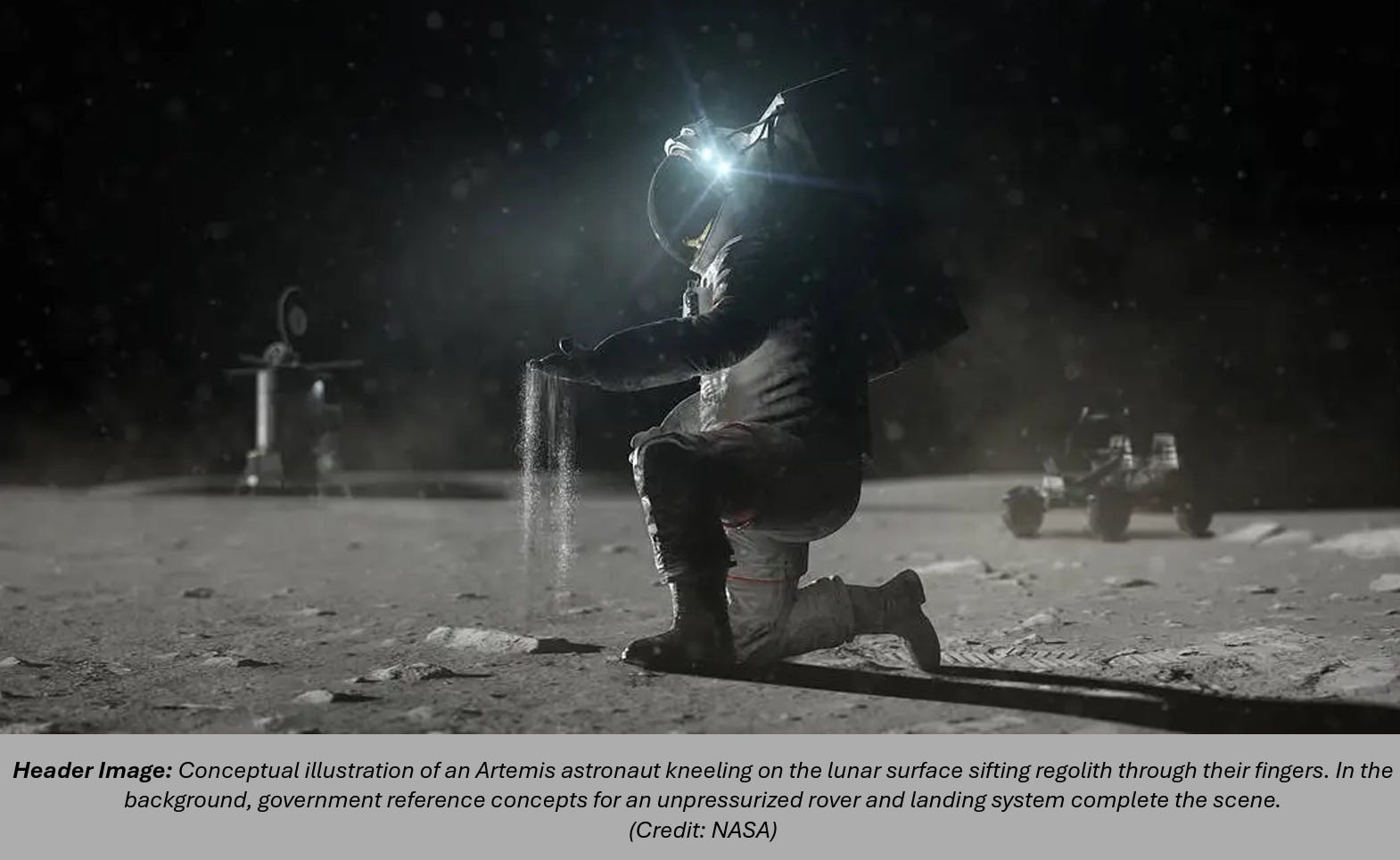
I want to read these documents carefully, in this essay, because they offer a clear view of what architecture looks like when it operates at planetary scale and beyond, and I think the discipline needs more practitioners who can see them as architectural in the first place. This is not obvious. The documents are written in the language of procurement. They describe themselves as systems engineering products. The institution producing them does not address the discipline of architecture and the discipline of architecture has so far had almost nothing to say about them. To recognize them as architecture, in the sense that matters, requires a particular kind of attention that is not currently part of the discipline’s standard formation.
The white paper opens with a claim about the structure of any exploration architecture. Such an architecture must answer a set of guiding questions: Why we go, Who is involved, Where we go, What we do there, When do we go, How we go. These six questions are what the agency calls a trade space, a range of possible options whose answers shape the world that gets built. The order in which the questions are asked determines the architecture more than any individual answer. Apollo, the paper argues, foregrounded When, because Kennedy’s mandate was a deadline, and the result was an architecture optimized for schedule rather than for extensibility. The Moon to Mars program foregrounds Why, which means that all subsequent answers cascade from the agency’s exploration objectives rather than from a calendar. The architecture, in this account, is the sequence of questions and the dependency graph that connects their answers.
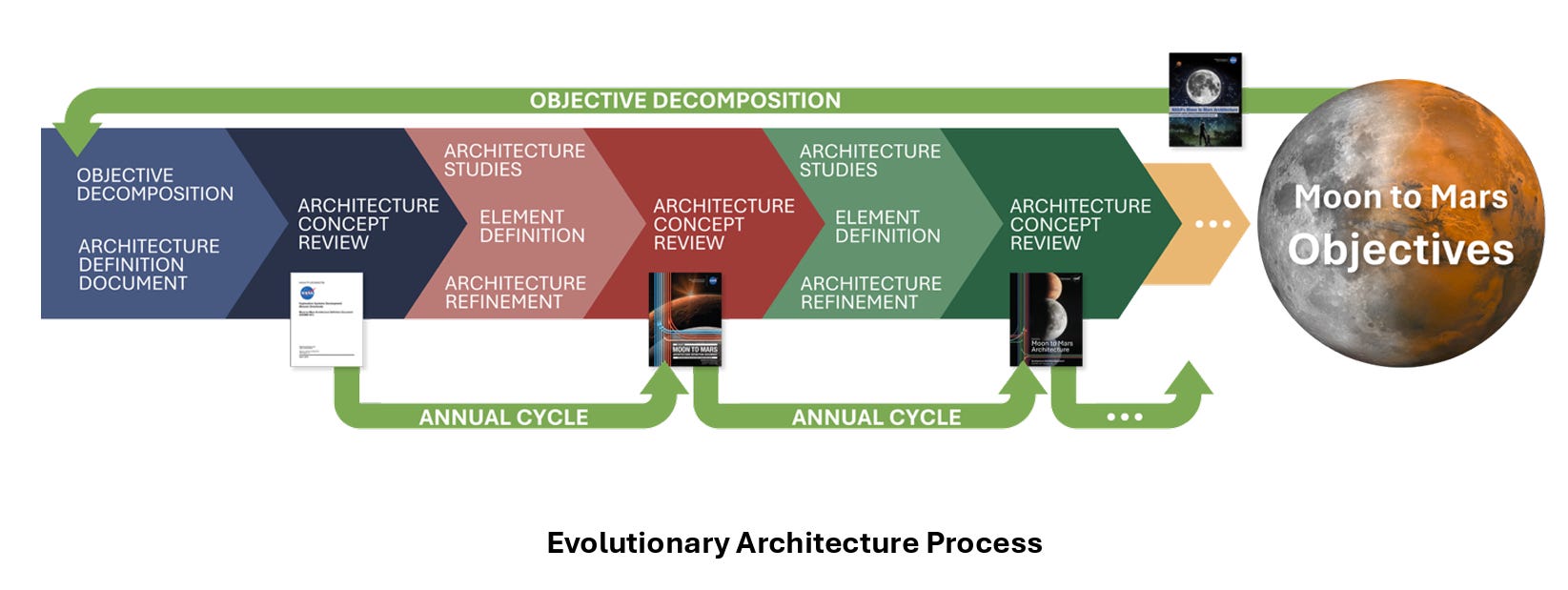
The method has a name. NASA calls it architecting from the right, where right refers to the right-hand side of a long timeline. The agency begins with its broadest goals, the farthest in the future, and works backward toward the present. The objectives at the right side of the timeline are decomposed into characteristics and needs, which are the qualities the architecture must have if the objectives are to be reached. The characteristics and needs are then decomposed into functions and use cases, which are the specific operations the architecture must be able to perform. The functions and use cases are then grouped into elements and reference missions, which are the actual systems and hardware that will provide the capabilities. Each step of the decomposition is tracked. Each function has a parent characteristic, each characteristic has a parent objective, and the lineage from a piece of equipment on the lunar surface back to a stated reason for going to space can be traced through the model. The architecture is, quite literally, the cascade. It is also, at its core, a discipline of timeline thinking. The agency is designing across decades, with each priority decision understood in terms of its position on the timeline and its flow-down effects on subsequent positions. Time, in this method, is not a container in which the architecture sits. It is the material the architecture is made of.
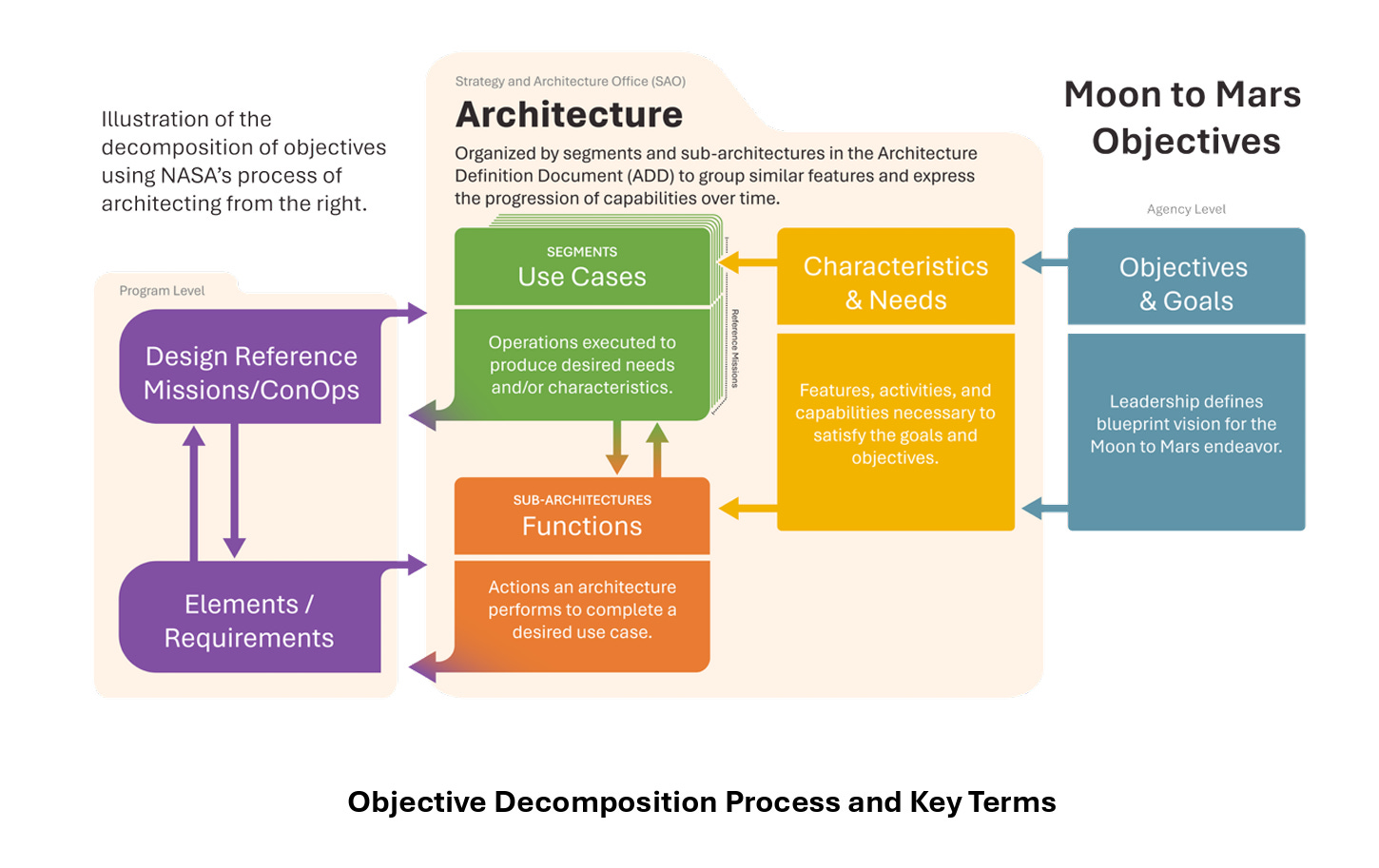
This decomposition is held in what NASA calls a model-based systems engineering environment. The phrase is technical but the operation it describes is straightforward. Every objective, characteristic, need, function, use case, and element exists as an object in a database with traceable relationships to every other object. When a function is added or modified, the database updates the chain of dependencies that follow from it. When an element is selected to fulfill a function, the model records which other elements are now constrained by that selection. The Architecture Definition Document is the readable surface of this model, generated annually for public release, but the model itself is the live artifact, continuously maintained, queried by NASA’s architecture teams to assess the consequences of any proposed change. Architects in the discipline of architecture maintain plans and sections. NASA maintains a graph.
The model contains, among many other things, a catalog of architecture-driven technology gaps. These are capabilities the architecture requires but cannot currently accomplish with existing technology. The gaps are defined, in the agency’s own phrase, in solution-agnostic terms. The catalog does not specify how a problem should be solved, only that a capability is needed and what the capability must do. Gap FN-P-101 names the need for power generation in the lunar south pole region. Gap FN-A-104 names the need for robotic manipulation of payloads on the surface. Gap FN-H-102 names the need for a pressurized habitable environment of moderate duration. Each gap is published openly so that industry, academia, and international partners can see where the agency requires innovation, and so that proposed solutions can be evaluated against an articulated need rather than a predetermined technology. The catalog is, in effect, a public specification of the parts of the architecture that do not yet exist, written in a vocabulary that invites participation without prescribing form.
Within this method, certain decisions are designated as priority decisions because their flow-down effects constrain many subsequent decisions. The 2024 selection of nuclear fission as the primary surface power generation technology for initial human missions to Mars is the worked example NASA cites most often. The agency had examined a range of power sources, weighing each against criteria of mass, power output, safety, and suitability to the Martian environment. The selection of fission closed certain branches of the trade space and opened others. With the technology selected, NASA could begin developing the infrastructure that would be possible only in a world powered by continuous fission output. The decision was architectural in the most precise sense. It was a determination that organized everything downstream from it, a ground rule from which the rest of the project’s grammar would be derived. The priority decisions are the points at which the trade space narrows substantially, and the digital tooling allows NASA to assess what happens to the rest of the architecture when any of these decisions is delayed or accelerated.
The decomposition is updated annually through the Architecture Concept Review cycle, in which NASA’s architecture teams perform trade studies, identify new gaps, document closed decisions, and revise the model. The cycle is collaborative. The agency holds workshops with industry and international partners. It publishes feedback summaries from the previous year. The 2024 feedback document, included in the workshop materials for 2025, notes that stakeholders appreciated transparency regarding decisions and decision-making, that industry desired more clarity on the agency’s investment priorities, and that industry and academia would appreciate being involved earlier in the gap definition process. These are the stated needs of the constituencies the architecture is being produced for, and the architecture is being adjusted in response. The model is not just a private engineering tool. It is the medium through which a multi-decadal project negotiates with the publics that will build it.
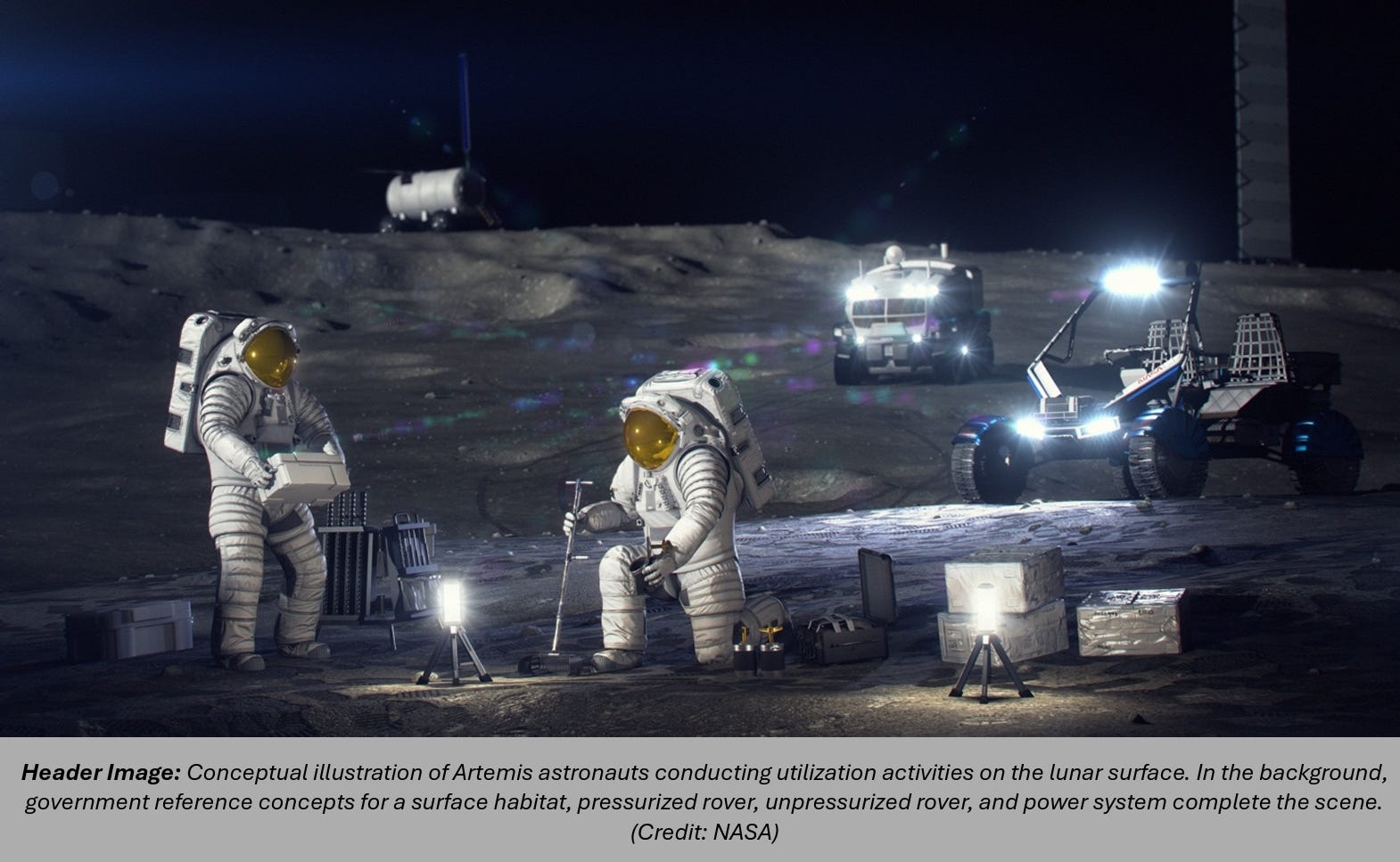
What the white paper makes visible is that architecture in its most ambitious contemporary form is the management of a possibility space. The Architecture Definition Document is not a description of the Moon Base. It is a maintained model of every decision that could still be made about it, with the dependencies between those decisions tracked in the digital environment, with priority decisions identified through the roadmapping process, with a partial ordering of the questions to be answered each year. The architecture is the trade space. The base, when it is eventually built, will be one path through that space, one sequence of definitions closed off in a particular order. Most of the architecture will never be instantiated. It will exist only as the field of possibilities that were considered and then narrowed.
This is a worldmaking grammar of unusual rigor. The model is not a representation of the project. The model is the project. The lunar base, considered as an artifact, will be a particular collapse of the model into a single instantiated path. Considered as a process, the base is the model, maintained across decades, narrowed asymptotically toward an actual surface. The architecture is the model, and the model is the architecture, and the inhabited base will be the residue of the modeling.
The world that gets produced through this method is a world of maximum legibility. Every gap is identified. Every dependency is mapped. Every priority definition is sequenced. The agency maintains, through its annual review cycle, a model in which nothing is permitted to remain unspecified. The trade space is exhaustive in principle, which means that the world being procured is one whose conditions of inhabitation can be enumerated in advance. The lunar South Pole, in this account, is a destination whose surface properties can be characterized through additional missions whose data will close the relevant gaps, whose darkness can be survived through the development of extreme temperature-tolerant mechanisms, whose dust mechanics will be modeled with sufficient fidelity to inform the design of dust-tolerant connectors. The Moon, as it appears in the documents, has no remainder. There is no aspect of the place that is permitted to exceed the model.
This is the cosmological claim embedded in the procurement vocabulary. The trade space is exhaustive. The roadmap is complete in principle. A world of maximum legibility is, by construction, a world that has no register for what cannot be made legible. The illegible does not exist within the architecture. It exists only as the eventual remainder when the architecture meets the place it was designed to procure.
The reason this is worth reading carefully is that the operations the document describes are continuous with what architecture has historically been about, even though the vocabulary has changed beyond recognition. Architecture has always been the discipline that produces specifications for inhabited futures. The specifications used to be drawings of buildings. They are now maintained models of decision spaces. The shift is real and worth understanding, but it is a shift within architecture, not a departure from it. The Moon Base is being designed by people whose training is in aerospace systems engineering rather than in architecture, but the work they are doing is recognizably architectural work. They have arrived at this work because the discipline did not arrive there first. The vocabulary they have developed is the vocabulary that was needed for the scale they are working at, and the discipline of architecture has not, on its own, developed a comparable vocabulary for the same scale.
There is a deeper reason for this absence and it is worth naming directly. The discipline’s foundational toolkit, the orthographic projection, the plan, the section, the elevation, the Cartesian coordinate system itself, was developed to specify objects in an abstracted space outside of time. The plan freezes a building at a single moment, viewed from above, with time removed. The section is the same operation in a different orientation. These instruments were extraordinary inventions. They made possible the entire trajectory the discipline has followed since the Renaissance, and the buildings and cities they produced are not small accomplishments. But they are fundamentally spatial instruments. They have no temporal dimension. They cannot natively represent a world that is being defined across decades, that exists as a maintained possibility space, that has priority decisions whose flow-down effects organize the meaning of subsequent decisions. The plan can show what a building looks like. It cannot show what an architecture looks like in the sense the Architecture Definition Document means. The discipline cannot see NASA’s documents as architectural in part because the discipline’s instruments cannot represent what those documents actually are. The standard toolkit was developed for a different ontology, and the world-images of the present moment require notations the discipline has not yet developed. New scales require new instruments. The Cartesian grid did extraordinary work for the building and the city. It cannot do the work for the multi-decadal phased deployment of an inhabited planetary site, and the discipline’s continued orbit around its older logic is one of the reasons the planetary scale of operations remains, for most architects, perceptually invisible.
The new instruments are already emerging, and they are emerging from a co-evolution between three technologies that the discipline currently engages, when it engages them at all, as separate concerns. Simulation handles the temporal evolution of systems. AI handles the management of large possibility spaces and the generation of representations that exceed manual production. Real-time mapping handles the continuous registration of actual conditions as they change. None of these alone is a spatio-temporal toolkit. Together, in a co-evolutionary process where each pushes the others to develop further, they are becoming one. AI is now being trained on simulation outputs. Simulations are being instrumented with real-time data feeds. Real-time mapping is being interpreted by AI inference. The boundaries between the three are dissolving, and the systems being built today already work across all three registers as a matter of course. The Moon Base documents, the procedural geometries of game engines, the climate models that inform infrastructure planning, the digital twins of cities and ports and supply chains, all of these are operating in the space where simulation and AI and real-time mapping interpenetrate. The Cartesian toolkit took centuries to develop, through the slow co-evolution of geometry, optics, paper technology, printing, surveying instruments, and the institutional structures that taught architects to use them. The spatio-temporal toolkit will not take centuries because the underlying technologies are developing on a different timescale, but the same kind of co-evolutionary process is happening, compressed into years and decades rather than centuries. The discipline that participates in this process will shape the toolkit it inherits. The discipline that does not will inherit a toolkit shaped by other concerns, designed by people thinking primarily about logistics, prediction, optimization, and capital flow. The toolkit will work well for what it was designed for. It will work less well for what worldmaking requires.
The position I want to propose, which is the position the Worldmaking Project has been working toward across its essays, is that architects and designers ought to be able to read documents like these as part of their own field. Worldmaking is the name for the kind of practice that operates at the scale of inhabited futures, that produces world-images rather than objects, that takes responsibility for the cosmologies its specifications carry. It is a position that includes the design of objects and buildings but is not exhausted by it. It is a position that includes the design of cities and regions but is not exhausted by those either. It is a position from which the Moon Base is recognizably architecture, the procedural geometries of a game engine are recognizably architecture, the digital environment that holds NASA’s trade space is recognizably architecture, and the work of integrating these registers into a coherent practice is the work the discipline now needs to be doing.
I want to be specific about what this means in practical terms, because the position is no use if it remains abstract. A worldmaking architect needs to be able to read a systems engineering document and recognize what kind of world it is specifying. This requires technical literacy the discipline does not currently teach. We need to develop a serious practice of timeline thinking, because the artifacts that matter at the scales worldmaking operates at are temporal artifacts in their constitution, defined across decades and maintained as living models rather than completed at a moment. The cultural appetite for this kind of thinking is already visible in the speculative timeline videos circulating online, the projections of 2050 or 3000, the predictions of phased futures, which are mostly not serious projects but reach toward an attention the present moment plainly wants and the discipline is currently not training. They need to participate in the development of the spatio-temporal toolkit, which means working seriously with simulation, AI, and real-time mapping not as separate technologies but as the convergent instrumentation through which contemporary world-specifications are increasingly produced. They need to maintain the disciplinary vocabulary for thinking about cosmology, partiality, opacity, and the gap between specification and inhabitation, because this vocabulary is what the procurement institutions do not have and what worldmaking architects can specifically contribute. And they need the historical formation that allows them to see continuities between Alberti and the Architecture Definition Document, between Superstudio and the simulation engineer, between the long traditions of speculative urbanism and the contemporary work of specifying inhabited futures at planetary scale. This formation is not currently the standard education of an architect. It is, however, the education the discipline now requires.
The reason this matters more than it might seem is that the institutions producing world-specifications at large scale do not have, on their own, the conceptual equipment to think well about what they are doing. NASA’s documents are impressive within their register, but the register has limits. The procurement vocabulary cannot ask whether the cosmology embedded in a maximally legible architecture is the cosmology a multi-decadal inhabitation actually requires. It cannot ask what kinds of inhabitation the trade space methodology forecloses. It cannot ask what publics the dependency graph addresses and which it leaves out. These questions are architectural questions in the sense the discipline historically claimed, and they are not currently being asked by the practitioners producing the documents. They could be asked, and the documents could be improved by the asking, if the discipline were producing architects who could enter the conversation as peers rather than as observers.
The worldmaking position is also a position from which a number of confusions in the contemporary discipline become legible. The reactionary response to AI tools, which has occupied a great deal of professional discourse in the last few years, looks different when seen from this position. AI tools are doing operations the discipline used to theorize and has stopped knowing how to think about. The production of representations, the iterative narrowing of design parameters, the negotiation between specification and image, the management of large possibility spaces. These are all things architecture has long histories of working with. The reactionary response is what happens when something arrives that the formation cannot place. From the worldmaking position, AI is a set of tools that worldmaking architects need to be conversant with, and the productive question is how to use them well rather than whether to permit them. The same shift in attention applies to the planetary scale of operations. The position that registers the Moon Base as exotic, as not really architecture, as the business of other professionals, is the position of a formation that has narrowed its perceptual field. The position that registers it as architecture is the worldmaking position, and the difference between the two is not ambition or politics. It is attention.
There is a wider stake worth naming. The Moon Base documents are a template. The same procurement grammar, the same trade space methodology, the same maintained digital model of an inhabited future, is being developed in parallel for Mars. It will be developed for orbital infrastructure, for asteroid resource extraction, for the planetary-scale climate adaptation projects that the next century will require. The form being worked out at the lunar South Pole is the form in which large-scale inhabited futures will increasingly be specified, on Earth and elsewhere. A discipline that produces architects who can engage these specifications as peers will be in a position to shape the worlds they describe. A discipline that does not will receive them as fait accompli, the way it currently receives zoning decisions and developer pro formas, and adjust its production to fit. The choice is not whether the discipline will be involved. It is whether the involvement will be substantive or marginal.
The interesting question that follows from all of this is not whether maximum-legibility architecture can produce a place worth inhabiting. The Moon Base will be inhabited, and the inhabitation will, in many of its aspects, work. The interesting question is what happens at the edges of the trade space, where the model meets the part of the place that was not in the model. The lunar South Pole, when humans actually arrive there for sustained periods, will not behave like the dependency graph. The regolith mechanics, the dust electrostatics, the long shadows cast by emplaced infrastructure that were not anticipated when the infrastructure was specified, the cumulative effect of partial gravity on the human body across years rather than months, the accidents that the loss-of-mission risk methodology cannot model because they have not yet occurred. These will not be gaps the trade space failed to close. They will be the parts of the world that were never inside the trade space at all. They will also be the parts that the discipline of architecture, in its older sense, has the longest history of attending to. Buildings have always exceeded their drawings. Sites have always exceeded their surveys. Inhabitants have always made worlds out of what was specified for them and what was not. A worldmaking practice would be the practice that holds both registers at once, the maintained model and the eventual remainder, the specification and what exceeds it.
The User’s Guide closes with a photograph, taken on April 6, 2026, by the Artemis II crew during their flight around the Moon. Earth is rising over the lunar limb. The pamphlet’s caption notes that the image is reminiscent of the iconic Earthrise photograph taken by Bill Anders fifty-eight years earlier as the Apollo 8 crew flew around the Moon. The Anders photograph was unplanned. The astronaut had been photographing the lunar surface and looked up. The Artemis II photograph is deliberate, framed, citational, arriving into a media environment that has already exhausted the original. It is the architecture’s attempt to import a moment of inhabitation that the architecture as written cannot specify.
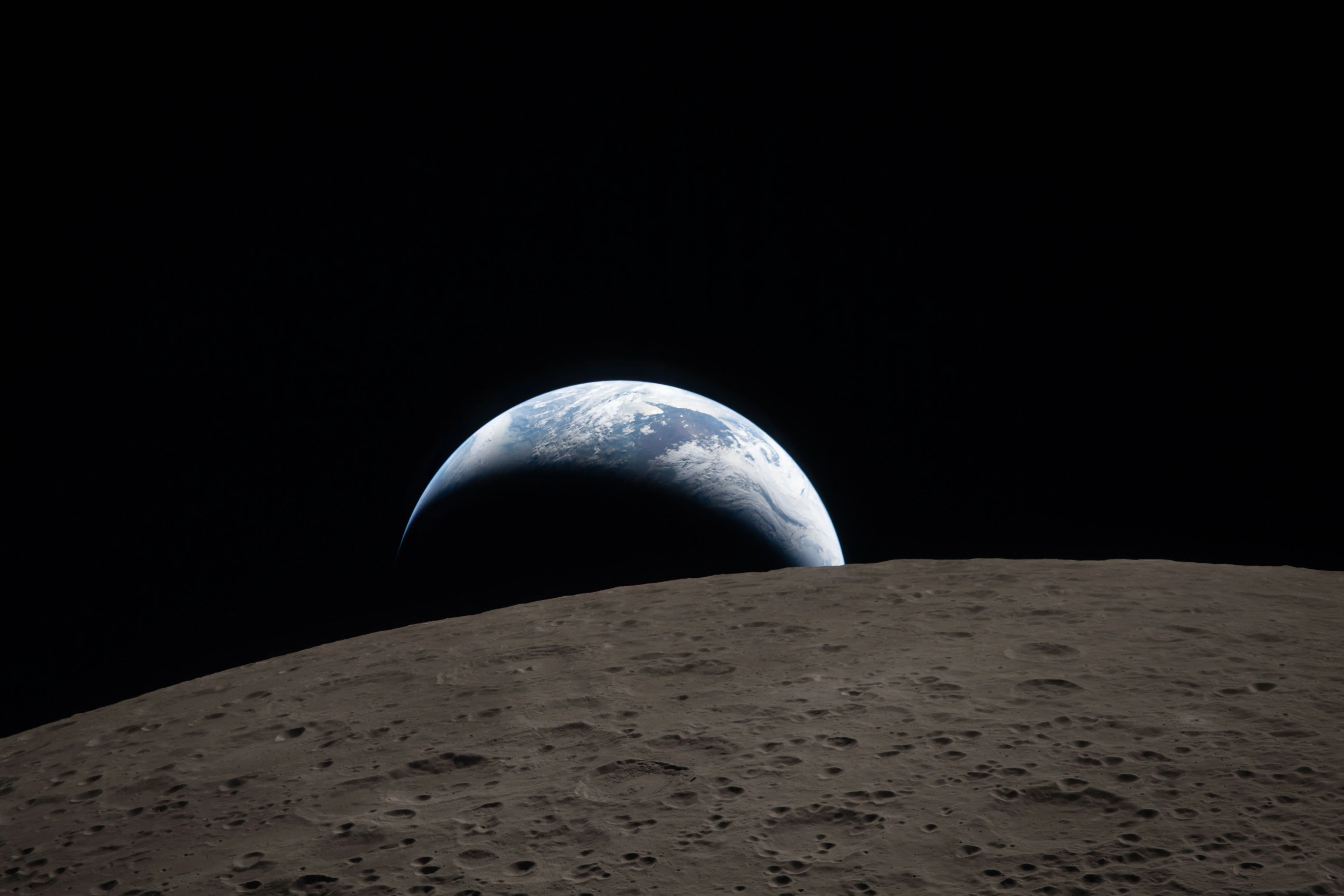
Earthset, NASA, 2026
The base, when it is built, will produce other such moments. They will be the parts of the world that were not in the trade space. The architects of that world are the people producing the trade space now. The discipline currently has no practitioners formally trained to enter the room as their peers. The work of producing such practitioners is the work the discipline now needs to be doing, and the position from which that work begins is the position this Substack has been calling worldmaking.
Sources and further reading
Moon to Mars Architecture program (gateway to all related documents) https://www.nasa.gov/moontomarsarchitecture/
Moon to Mars Architecture Definition Document, Revision C (2025) https://ntrs.nasa.gov/api/citations/20250010956/downloads/20250010956.pdf
Index of all ADD revisions
https://www.nasa.gov/moontomarsarchitecture-architecturedefinitiondocuments/
Moon Base Architecture User’s Guide (April 2026) https://www.nasa.gov/wp-content/uploads/2026/04/moon-base-architecture-users-guide.pdf
“Architecture Definition” white paper (2025 ACR) https://www.nasa.gov/wp-content/uploads/2025/12/acr25-wp-architecture-definition-v3.pdf
Full set of Moon to Mars white papers https://www.nasa.gov/moontomarsarchitecture-whitepapers/
“Architecting from the Right” (objective decomposition methodology and digital decision roadmapping) https://www.nasa.gov/moontomarsarchitecture-architectingfromtheright/
Architecture Concept Review (annual ACR cycle) https://www.nasa.gov/moontomarsarchitecture-architectureconceptreview/