

The Institutional Uncanny
From The X-Files to SCP, Control, and Severance

I have been reading There Is No Antimemetics Division on and off for a few weeks. The premise is straightforward: if a meme, in the broadest sense, is an idea that spreads, then an antimeme is an idea that resists being remembered, transmitted, or shared at all. Some antimemes are mundane, of the kind we live with every day: passwords held in working memory only as long as the screen is in front of us, taboos that suppress their own articulation, the long blocks of random characters that fall out of your head as soon as you look away. Others, in the world of the novel, are anomalous, and far worse than mundane: entities that cannot be perceived directly, predators that erase themselves from the memory of their prey, cosmic-scale objects through which humans walk without ever registering them. The Antimemetics Division is the wing of a secret institution responsible for cataloging, containing, and fighting these things, and its researchers take mnestic drugs in order to retain awareness of phenomena that would otherwise dissolve out of their consciousness. The division’s job, put plainly, is to remember what is designed to be unrememberable, which makes the book a war novel set inside an archive that is forgetting itself.
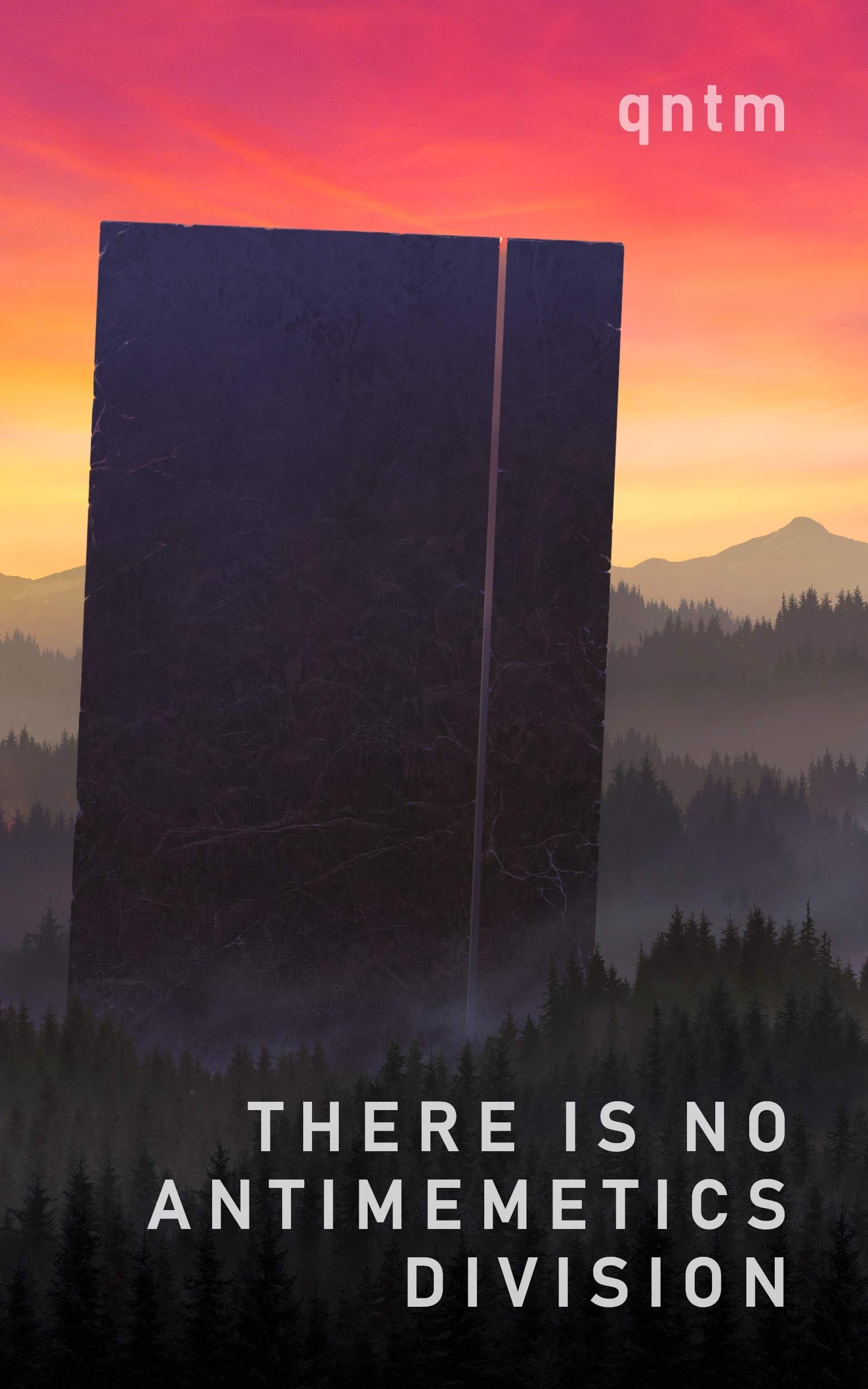
The cover of the first printed edition. Written by Sam Hughes and first published in 2021, based on stories originally released on the SCP Foundation wiki. The novel follows a secret division tasked with remembering entities designed to erase themselves from human memory.
What keeps drawing me back is not the cosmic horror, though there is a fair amount of that. It is the texture of the prose, which moves between the clinical and the narrative, accumulating case files and blacked-out names and passages in which a sentence reaches a redaction and the redaction is the sentence’s actual content, because the thing being concealed is the thing the institution cannot afford to articulate. Reading the novel does something to your attention, training you to take the bureaucratic register as the evidentiary basis of what is real and the redaction as the form’s mark of what exceeds it.
This is the institutional uncanny in its purest contemporary expression, an institutional apparatus that, applied to anomaly, generates conviction on the strength of its own paperwork. The world becomes real because the paperwork is real, and what the paperwork cannot say turns out to be the part that matters most.
I want to follow this form back through a small set of works that have produced it, because it is one of the central worldmaking modes of the last thirty years and it has not yet been thought through as such. The earliest version I want to attend to is The X-Files, which gave the bureaucratic uncanny its broadcast vocabulary, the manila folder and the redacted memo and the field report read aloud in a basement office. The SCP Foundation then took the same vocabulary and removed the protagonists who had been needed to humanize it, building an open archive in which the institutional voice became the form’s only voice. Remedy’s Control eventually brought the archive into playable space, letting the inhabitant walk through the building that had been writing the files. Each transformation moves the inhabitant a little further inside the institution, and each one is enabled by a different medium becoming available to host the form, with the present moment looking less like a convergence on synthesis than like a branching out, in ways worth attending to, because the institution is increasingly the medium through which the contemporary makes itself believable.
The X-Files and the Documentary Uncanny
The X-Files invented an affective signature so durable that the rest of the lineage runs on its residue. The manila folder, the field report, the redacted document, the photograph with a date stamp in its lower right corner, the slide projector clicking through evidence in a darkened room, the audio recording with its constant static hiss: these are not narrative devices the show occasionally deploys but the substance through which the show makes its world stick. The aesthetic vocabulary is the worldmaking, and almost everything that comes after in this lineage is a working out of what that vocabulary can do once the surrounding conventions of broadcast television are subtracted from it.
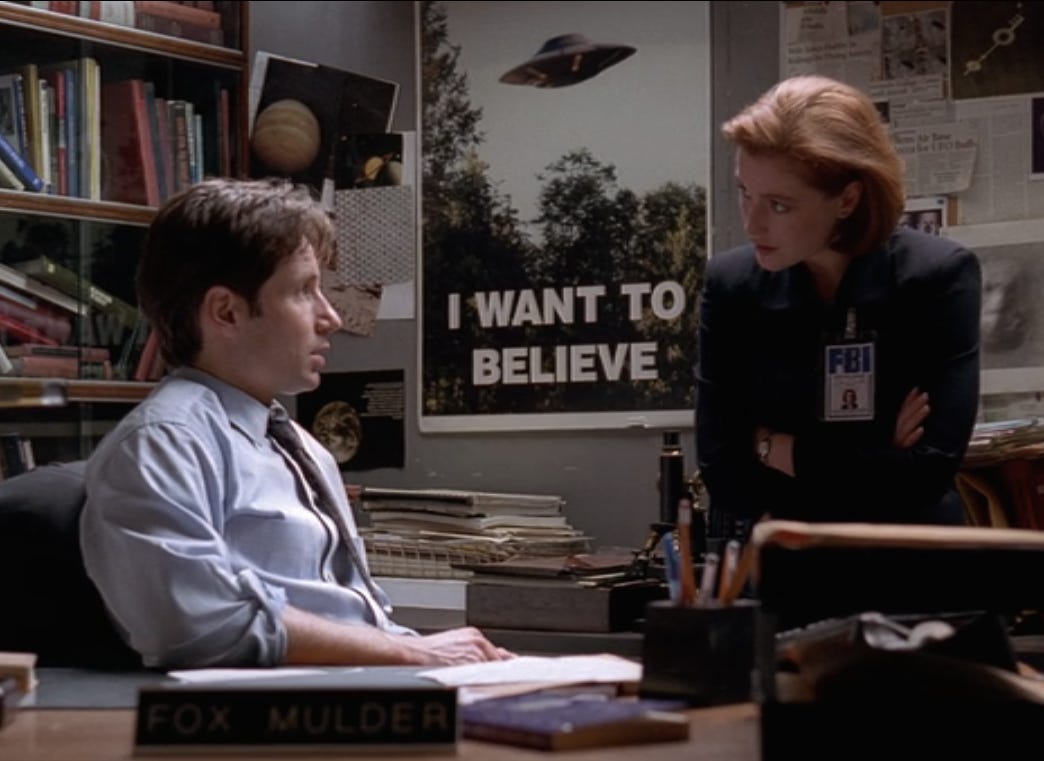
X-Files, Created by Chris Carter, first aired in 1993. The series follows FBI agents Fox Mulder and Dana Scully as they investigate paranormal cases through reports, photographs, and classified files.
The genius of the early seasons is that the supernatural is always presented through the form of its institutional documentation, which is to say that a creature is never encountered as such but always already filed. By the time Mulder shows the photograph to Scully, the photograph has already become an FBI document with the implicit weight of a federal bureaucracy behind it, and the viewer is therefore shown not the thing but the paperwork the thing has produced, with the paperwork doing the work of conviction.
This is what distinguishes the X-Files from the horror and science fiction that preceded it, and the distinction is one of form rather than of intensity. The show is procedural rather than mythic, holding its world together through the apparatus that catalogs it rather than through any direct encounter with the apparatus’s limits. The truth is out there, in the show’s famous formulation, but it is out there in the way that truths are out there for an investigative bureaucracy, which is to say that there is a file on it somewhere, waiting to be opened.
What the X-Files cannot quite let go of is the protagonists. Mulder and Scully are the consciousness through which the archive is processed, the two faces through which the bureaucratic uncanny is delivered to a broadcast audience, which means the viewer never quite reads the file directly but instead watches the file being read, argued about, lit by the desk lamp at three in the morning. This is a constraint of broadcast television in the 1990s rather than a flaw of the show. The audience of the time needs someone to identify with, and the institution by itself is not yet legible as an aesthetic object, not yet trusted as a worldmaking medium in its own right.
The SCP Foundation and the Wiki as Archive
The X-Files runs from 1993 to 2002, and somewhere in the middle of that arc the internet begins to do what television could not, which is to host institutional documents directly, without the mediation of protagonists who interpret them for us. The SCP Foundation begins on 4chan in 2007 with SCP-173, a concrete statue that moves when no one is looking at it. The entry is written as an internal containment procedure, without narrator or protagonist or any of the usual machinery of fiction, in a voice that belongs entirely to the institution that has decided how to file this thing. From the start, the form’s signature gesture is to subtract the human consciousness that would normally mediate the encounter, leaving only the document and the procedural language in which the document is composed.
What happens over the next several years is the slow accretion of a vast collaborative archive, written by thousands of contributors, in which the institutional voice becomes the principal aesthetic. By the time SCP has accumulated nine thousand entries it has long stopped being a horror site, having become instead a worldmaking apparatus that has dispensed with the consoling fiction of authorship altogether. The Mulders and Scullys are gone. What remains is only the Foundation, writing about itself in the clinical register of a research bureaucracy that has decided, on its own and without the mediation of a protagonist consciousness, what counts as anomalous and what counts as contained.
The reader of SCP, with the protagonists subtracted, becomes the consciousness that traverses the archive directly. There is no narrative path through it and no recommended reading order; you enter through whatever entry catches your attention and follow from there the cross-references, the addenda, the joke entries that comment on the form itself, the metanarrative tales in which Foundation researchers grapple with the existential cost of their own classification system. The archive is browsable in any direction at once, and the world emerges through the act of browsing rather than through the act of being told a story, which is something the X-Files could not do because broadcast television cannot, by its nature, be browsed.
What SCP also makes available is the form’s reflexivity about its own limits, and the antimemetic entries are the clearest case. SCP-055 is the prototype, an object whose property is that nothing about it can be remembered; the entry consists almost entirely of researchers reconstructing what they have just forgotten, building a description out of the absence the object leaves in their attention. SCP-3125 is the apex antimeme, an entity that cannot be safely known. Entries of this kind are the institutional form openly admitting that it has reached the place where its classificatory operation cannot complete, and the redaction in them is no longer the kind that conceals a fact stored elsewhere in the file but the kind that marks, on the surface of the document, the place where the form itself runs out.
This is the point at which the institutional uncanny becomes properly philosophical, the moment when the institution stops merely classifying the strange and begins mapping the boundary of its own capacity to classify, producing as its world precisely the world in which that boundary becomes visible.
It is also the point at which the SCP form begins to escape containment, so to speak, and to enter other media. There Is No Antimemetics Division is the first major artwork to take the SCP register and develop it at the length of a novel, and it could only do so because the wiki had already trained a generation of readers to take the institutional document as a self-sufficient aesthetic object. The novel does not have to explain its form, because by the time Hughes started writing in 2015 what had been an internet curiosity in 2007 had become something closer to a literacy, with readers who knew how to inhabit the Foundation and a form that could be trusted to do its worldmaking work without commentary.
Control and the Archive as Building
By the time Remedy’s Control releases in 2019, the institutional uncanny has been available in the culture for several decades, with the result that the game arrives at the form independently of the SCP wiki and through a network of influences including the New Weird novel and the unreliable-document literary tradition. The bureaucratic uncanny is no longer a niche aesthetic confined to a particular community but a form that has become available in the cultural water, and creators arrive at it independently because it answers something specific about how the present moment makes itself believable.
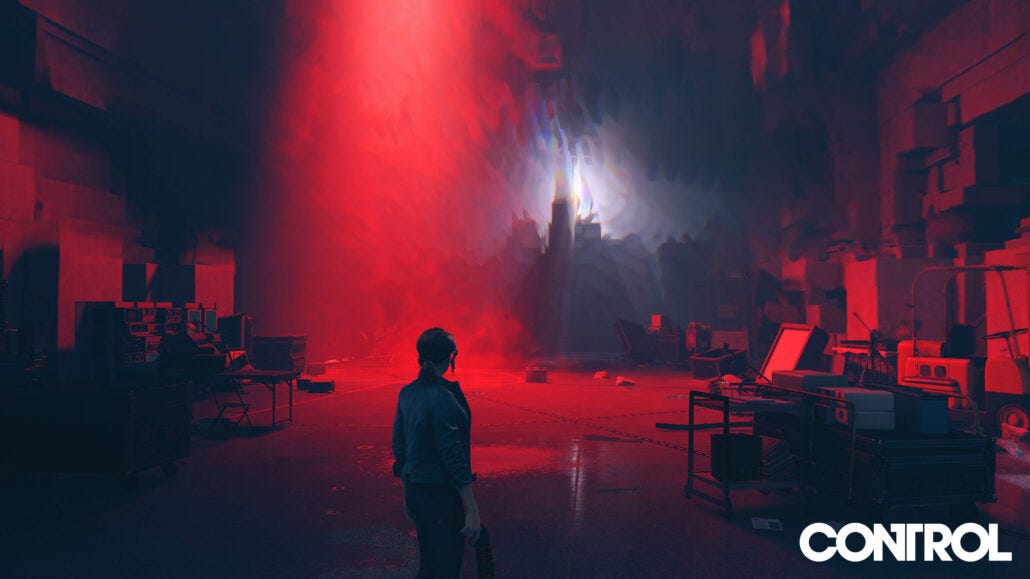
Control, Developed by Remedy Entertainment and released in 2019. The player explores the Oldest House, headquarters of the Federal Bureau of Control, where architecture itself functions as a living archive.
What Control does that neither the X-Files nor SCP could do is make the bureaucratic uncanny traversable. Jesse Faden enters the Oldest House, the headquarters of the Federal Bureau of Control, and the building itself turns out to be the archive: the Altered Items live in containment cells along its corridors, the case files are scattered through the environment as collectibles, the corridors themselves shift behind you as you move through them. The architecture is openly admitting that it is a system, a cosmology, a set of conditions that determine what can exist within it.
This is what makes the Oldest House significant in a way that goes beyond the game. It is architecture in the strong sense rather than the building sense, which is to say that it is not pretending to be a structure that happens to contain anomalies but is instead the anomalies’ relational field made physical, with the Bureau’s classifying activity producing a building whose interior geometry expresses the activity itself. The Oldest House becomes the FBC’s worldmaking apparatus rendered as walkable space, with the player’s task being to navigate the worldmaking from the inside rather than to observe it from the outside. The mediation between inhabitant and institution has thinned, with this game, to the point where it has almost disappeared.
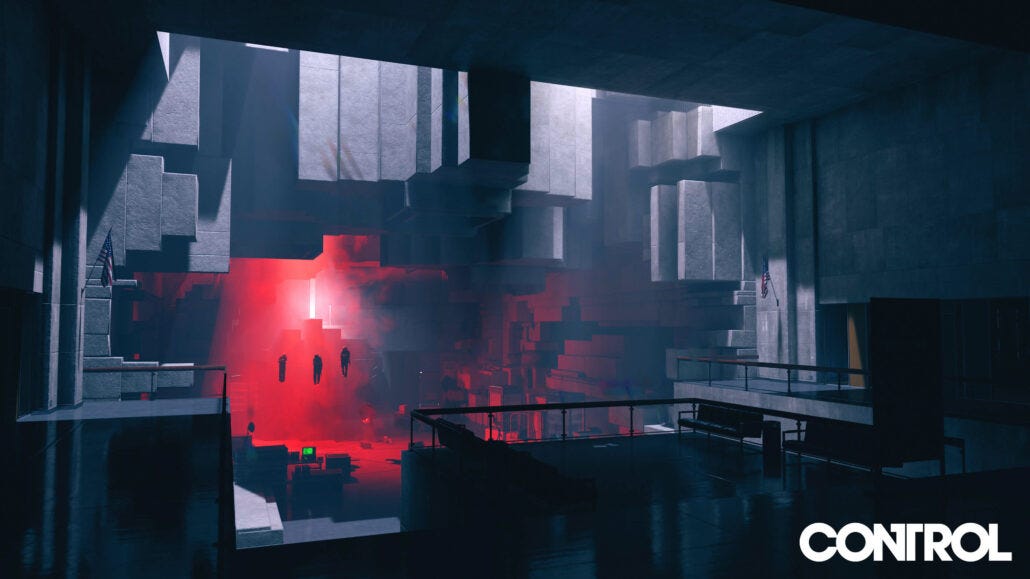
Control, 2019.
It is worth pausing on the redaction at this point, because it is the form’s most consistent gesture and it has been present at every stage. The X-Files redaction is the dark heart of the conspiracy, the thing the government has hidden from the public, while the SCP redaction is the institution’s own self-policing, the boundary of what the Foundation has decided is safe to share with its own staff. Control‘s redactions, scattered through the case files, inherit the rhetoric of both, but they do something subtly different: they mark the limits of the FBC’s own self-knowledge, since the Bureau is filing reports about itself, and those reports have blanks in them because the institution does not fully know what it is. The institutional uncanny becomes, at this point, reflexive in the deepest sense, with the institution no longer concealing the remainder so much as encountering it directly, and admitting that the encounter has produced gaps in its own paperwork.
The Institutional Argument
Across all three works, the institution is the worldmaking apparatus. The FBI in the X-Files, the Foundation in SCP, the Bureau in Control are not settings the worlds happen to take place in but the medium through which those worlds are produced, with the bureaucratic register itself doing the work of making anomaly into world.
There is a reason this form has become available in the way it has. The late twentieth and early twenty-first centuries are the period during which the institutional document becomes the principal mediator of public reality, in the form of the official report, the classified memo, the leaked file, the FOIA request, the redacted document released after litigation, the dossier, the case study, the regulatory filing. The contemporary subject’s relation to the truth is overwhelmingly mediated by paperwork, much of it produced by institutions whose interior workings remain invisible to those subjects, and the bureaucratic uncanny takes this condition and turns it back on itself, asking what it would mean if the paperwork were not the mediator of the world but the world itself.
Institutions have become one of the principal operational cosmologies of modern life, by which I mean that they have come to perform a substantial portion of the worldmaking work that earlier centuries entrusted to myth, religion, and shared narrative. Where an older cosmology offered a story about what the world is and what its parts mean in relation to a larger order, the institution offers a procedure, a classification, a containment protocol, a case file. The categories the institution uses become the categories through which the world appears: what is anomalous is what the institution treats as anomalous, what is contained is what the institution has filed under containment, what is real is what the institution has issued paperwork about. This is not a complete replacement of older cosmologies, which continue to operate in their own registers and continue to shape large parts of contemporary life, but it is a substantial shift in the locus of worldmaking authority. The institution does not need to explain the universe in order to organize one. It only needs to produce the documents through which the universe is administered, and the documents will do the worldmaking work that the explanations used to do. The fiction that takes the institutional document as its medium is registering this shift, and the institutional uncanny is the aesthetic name for what it feels like to live inside a world that has been brought into being by paperwork rather than by stories.
This is also the point at which the form connects to the philosophical issue of the remainder. Every system of classification operates by producing a residue, a category of things that cannot be filed without distortion or that cannot be filed at all, and institutions live with this residue by various means, redacting it, classifying it under conditions of restricted access, inventing specialized jurisdictions and divisions to handle what the rest of the apparatus would otherwise be unable to address. The bureaucratic uncanny is the aesthetic mode in which this residue becomes visible as the form’s primary content, which is to say that the strange object the form points us at is not the anomaly itself but the file the institution has produced about it, with all its admissions of incompleteness, its gaps, its addenda, its case-by-case revisions, its redactions. The file becomes the form admitting that it is the form, and the world it produces is held together by precisely that admission.
Three Branches
I want to close on three contemporary works in which the form is doing genuinely different things, because the question of whether Control is the endpoint of this lineage or one node in a continuing development matters for what the form is becoming.
Alan Wake II, Remedy’s 2023 sequel to both Alan Wake and Control, extends the form in a direction Control could not quite reach. Saga Anderson, the game’s FBI agent protagonist, is given the Mind Place, an interior spatial environment that she enters in order to organize her investigation, and within the Mind Place is the Case Board, a corkboard on which the player physically places photographs, documents, and clues in order to make deductions and unlock the next stage of the case. Where the Control player walked through the FBC’s archive as a finished spatial fact, the Alan Wake II player composes the case file as an ongoing act, which means Saga is both the investigator inside the case and the author of the case as it accumulates on her board. The structure folds back on itself: Alan Wake, the writer trapped in the Dark Place, is writing the very story Saga is investigating, so that the case file and the manuscript turn out to be the same object viewed from inside and outside. This is the institutional uncanny developing into something stranger, in which the institutional document is no longer only the form through which the world is filed but the form through which the world is being written, with the player asked to participate in the writing without ever quite knowing whether the writing is theirs or someone else’s.
Severance, Dan Erickson’s series, takes the form in a different direction entirely, transposing the FBC and the Foundation into the workplace. Lumon Industries, with its handbook and its containment procedures, its opaque internal departments and its founder whose pronouncements are quoted in the manner of scripture, is the institutional uncanny rebuilt around the corporation rather than the agency. What Lumon does that no earlier institution in this lineage has done is turn its classifying activity on its own employees. The severance procedure is the institution’s worldmaking gesture performed surgically on the worker, splitting consciousness into an innie who knows only the institution and an outie who knows everything else. With this gesture the institutional uncanny moves from anomaly containment to subject formation, and the institution stops being something that classifies the strange and becomes something that produces the strange by classifying the worker. This is a genuine transformation of the form, and it is doing things politically that the earlier works were not in a position to do, because the institution in Severance is no longer a fictional buffer between the viewer and a reality outside but the workplace itself, the worldmaking apparatus we already spend most of our waking hours inside.
Disco Elysium takes the form in a third direction, into ruin. The Revachol Citizens Militia is an institution barely surviving the conditions of the city it polices, and the case file Harry fills out, through the questionnaire on his clipboard and the copotype system that classifies him faster than he can classify anyone else, is the residue of a state that no longer functions but whose paperwork goes on being produced. The institutional uncanny here is what happens when the worldmaking institution itself becomes the remainder, the form continuing to do its work after the institution behind it has hollowed out.
These three works are not on a single line. They are three branches of a form that is still developing, each one taking the institutional document in a direction the others do not. One could add, as a fourth and even more radical case, Lucas Pope’s game Papers, Please, in which the player does not encounter the institutional document but performs it, stamping passports at an Arstotzkan border checkpoint and producing, with each stamp, the moral and political world on the other side of the counter, a version of the form in which the inhabitant has become the institution’s hand. The form is more alive now than it has been in any earlier period, because the contemporary subject’s relation to institutions has become more anxious, more reflexive, and more saturated, and what was a niche genre on broadcast television in the 1990s has become one of the principal aesthetic modes through which the present moment asks what kind of world an institution can still be trusted to produce.
If institutions have become one of the principal operational cosmologies of modern life, the fiction that takes their documents as its medium is not a curiosity of the last thirty years but a serious response to the contemporary condition. The institutional uncanny is the aesthetic that has emerged to register the fact that worldmaking has migrated, in the late twentieth and early twenty-first centuries, from the shared narrative forms of older cultures to the procedural forms of administrative life. This migration is not yet complete, and the older cosmologies persist alongside the new ones, but the institutional document is increasingly where the question of the world is being held open, and the lineage I have walked through is the principal aesthetic record of that holding. What these works are doing, in their different registers, is allowing readers and viewers and players to inhabit the new cosmology long enough to see what it costs and what it can do, what it produces and what it leaves out. The form is more alive now than it has been in any earlier period because the condition it registers is more pervasive than it has ever been, and because the contemporary subject has begun to suspect that the paperwork is not a layer over the world but the surface on which the world is being drawn.
The works I have walked through are points along an arc that does not yet have an endpoint. The form is older than the X-Files and will outlast the works that are doing the most with it now, and what interests me is the question of where the inhabitant will be standing when the next transformation arrives, because each version of this form has pulled the inhabitant a little further inside the institution it depicts: from the viewer in a basement office watching the slide projector, to the reader of the wiki opening the document directly, to the player walking through the building the documents describe. One direction worth attending to is already visible in Lucas Pope’s other game, Return of the Obra Dinn, in which the player reconstructs the casebook of an East India Company insurance assessor for a merchant ship whose entire crew is dead. The institution here is largely off-stage, and the institutional document is no longer a containment apparatus but a mourning device, the form by which a vanished world is recovered from the traces it left behind. Obsidian’s Pentiment extends the same impulse in a different register, letting the player participate in producing the historical record of a Bavarian town across several generations of manuscripts, chronicles, and confessions, with the documents that survive determining what later eras will be able to know. The institutional uncanny here begins to face backward, toward historical irrecoverability rather than toward anomaly, which is a register the form has not yet been pushed into at scale but which may turn out to be where it goes next, as the institutions that have become our cosmologies begin themselves to be the objects of the kind of reconstruction we used to apply only to the past. Whatever medium becomes available to host the form next will pull the inhabitant in further still, and the institution they will find themselves inside is, almost certainly, one we do not yet know how to recognize.
Notes
On the novel’s publication history. The copy I am reading is the original self-published 2021 paperback, the version Sam Hughes, who writes as qntm, assembled out of the stories he had been publishing on the SCP Foundation wiki between 2015 and 2020, in which the protagonist is still named Marion Wheeler and the institution she works for is still openly called the Foundation. In late 2025 Penguin released a traditionally published version that scrubbed the Foundation out and replaced it with the Unknown Organisation, renamed Marion Wheeler to Marie Quinn, and erased the wiki of origin so that the book could enter a wider literary world without the licensing complications of its collaborative substrate. The institutional substrate, in other words, had to be antimemetically removed in order for the novel to circulate, which means the book performs its own thesis on its publication history rather than only inside its pages. The institution that grew the novel was forgotten so that the novel could go on being read.
On terms. I am calling this the institutional uncanny rather than the bureaucratic uncanny because the worldmaking phenomenon I am tracing is not primarily about offices, forms, and procedures, even though those are the materials it most often works with. It is about the way institutions, broadly conceived, produce worlds, which is to say that it is about the FBI and the Foundation and the Bureau but also about the corporation, the police precinct, the publishing house, and the cultural commons in which forms come to be recognized. The bureaucratic register, with its case files and redactions and dry procedural voice, is the aesthetic surface through which the institutional uncanny most often appears, and I keep using the word bureaucratic throughout the essay when that surface is what I mean. But the larger phenomenon is institutional, and the form has branched into versions that retain the institutional structure while shedding the bureaucratic aesthetic.
On Twin Peaks. Running concurrently with the X-Files and trading signals with it in both directions, Twin Peaks was working with adjacent materials toward different ends, inflecting the FBI’s bureaucratic vocabulary with dream logic and lodge cosmology in ways that the institutional uncanny as I am tracking it here does not quite absorb. The Lynchian register is its own subject, worth its own essay.
On the influences behind Control. Sam Lake, who wrote the game, has said in interviews that he did not know about SCP until the project was well into development, framing pop culture as a kind of shared cauldron, a substance that many people contribute to and from which many people draw, and treating the resemblance between Control and SCP as evidence of the cauldron’s contents rather than of direct lineage. The game’s narrative lead, Anna Megill, has been more direct about the team digging through the SCP wiki during production, and has additionally cited Mark Z. Danielewski’s House of Leaves and Jeff VanderMeer’s Annihilation as foundational influences, which is to say that the literary precedents for what Control does are at least as important as the wiki ones.